Showing posts with label spirituality. Show all posts

Wednesday, June 20, 2018

Confluence & Ode to My Muscles

Image description: A young woman seen from behind, clutching the top of her head. The muscles of her back are strained and ridges of her spine visible. From Pixabay.
I'm taking a break from Kevarya this week to showcase some recently rediscovered poetry from 2015. It's somewhat hard to believe that three years have passed since I wrote these, but in a way, it makes sense, since they had started to fade from my memory.

Both poems deal with the relationship between mind and body, exploring both the positive and negative sides of physical awareness. Confluence contains references to characters you may recognize from other posts, while Ode to My Muscles deals with a topic I've rarely touched upon here: my experience as a disabled person.

So, without further ado, here's...

Confluence &

Ode to My Muscles


Wednesday, May 23, 2018

Kevarya: An Introduction to Magic

Image description: a silhouette of a raven in flight, magically vanishing into smoke, with a background of swirling nebulae and stars. Photo edit by Amanda Grace Shu.
Last week I promised you all some magic, so here's a look at the magic system of the Kevarya Universe. What happens when a powerful metaphysical force, unbound by the laws of nature, develops a mind of its own? Find out in An Introduction to Magic.

Saturday, November 26, 2016

Prophecy

Foreground digital painting of character i-Aten Elena drawn © Amanda Grace Shu 2016. Background image source credit to Frank Vincentz via Wikimedia Commons.
It's time to introduce you to a new character in the Kevarya Universe, one completely unrelated to the Royal Family with which A Winter's Ball was so concerned. Their name is i-Aten Elena, or just Elena, and they provide the first hint of magic at play.

Now a note about Elena. Elena is what's known as genderfluid, a term which may trip up some people. Genderfluidity, according to Genderfluid Support, can be defined as "the feeling of fluidity within your gender identity; feeling a different gender as time passes or as situations change; not restricted to any number of genders." Elena uses singular they pronouns (they/them/theirs). Is this grammatically correct? Yes, of course it is. The singular "they" was even named the American Dialect Society's Word of the Year in 2015. Pronouns have changed from plural to singular before, and since language itself is constantly changing, the idea of what is grammatically correct is rather, shall we say... fluid. Like gender. Or, for example, the nature of Time Itself.

Speaking of which...

Prophecy

Friday, February 26, 2016

Copper and Stardust

Photoshopped by me. Image source credit to NASA ([x] and [x]). The image of the stars is titled "Chaos at the Heart of Orion," which is an absolutely gorgeous title that I might use in a story someday.
Newer readers will remember A Winter's Ball, the first and currently only excerpt from a novel I am working on (read: doing everything but writing). This is a bit of world-building for that novel, exploring the Kevaryese culture's belief in how the universe came to be.

I have always loved world mythology, and particularly creation myths. It always surprises me how similar these ancient cultures' stories are in their imagery, even when many of the cultures had no way of interacting with each other. This myth doesn't have a Creator figure, but rather is centered around the idea that the world came from a union of sky and earth, as the Egyptians and the Ancient Greeks both believed, and the interaction between the darkness and the sun's light mirrors the Chinese concept of ying and yang. However, I like to think I added some unique elements to this story. I'll leave you to figure those out for yourselves.

So, without further ado...

Copper and Stardust:
A Kevaryese Creation Myth

Sunday, January 3, 2016

Translation: The Huron Carol

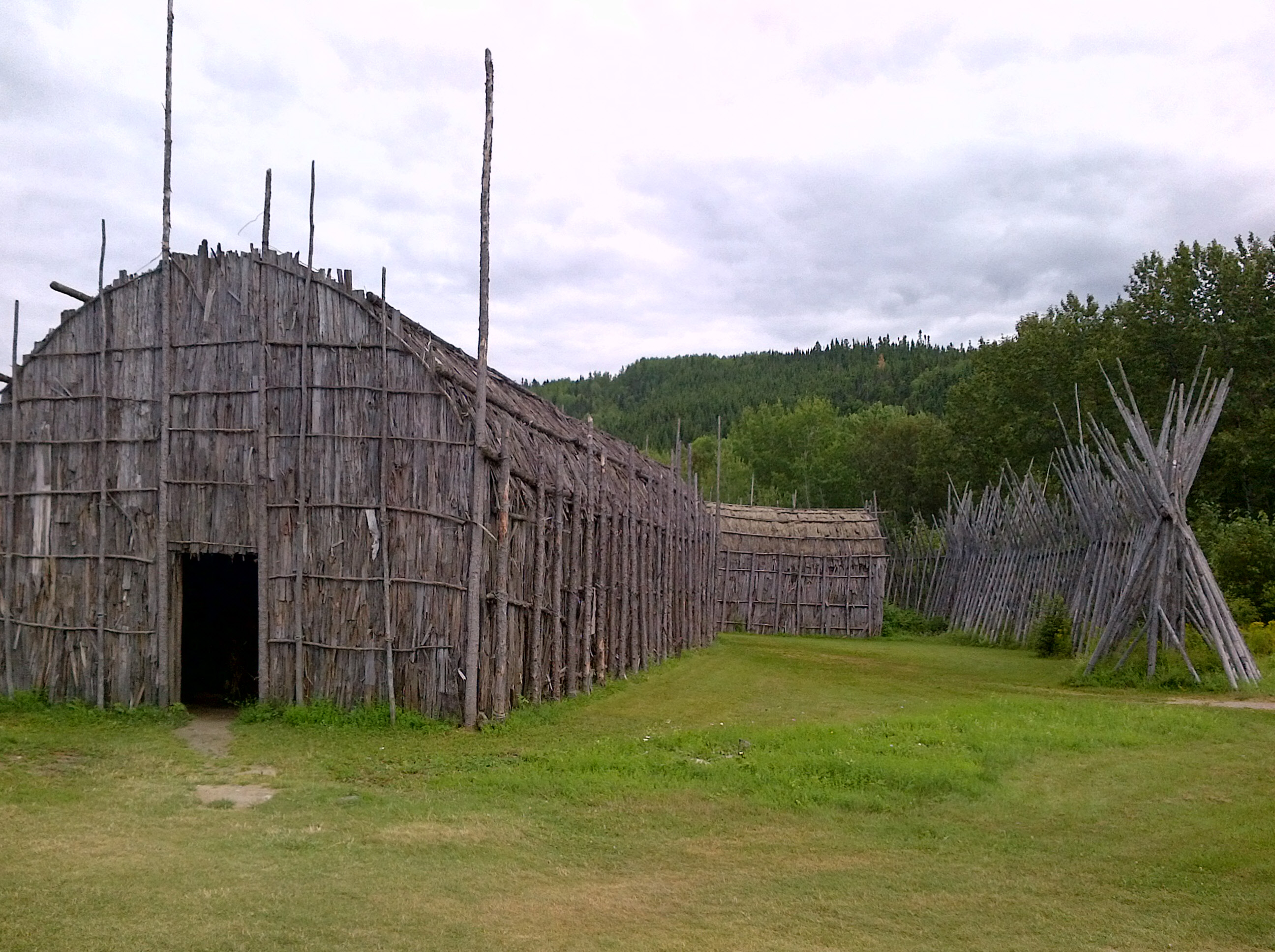
"Reconstruction of a Huron longhouse for the film "Robe Noire," site of la Nouvelle-France, Saint-Félix-d'Otis, Québec, Canada [tr. Amanda Grace Shu]." By Pierre5018 (Own work) [CC BY-SA 4.0 (http://creativecommons.org/licenses/by-sa/4.0)], via Wikimedia Commons.


I know what you're thinking. What's a Christmas carol post doing on my blog in January? Do I not know that Christmas is over?

Well, to that I say, 1) Hey, it ain't over until Epiphany happens, and 2) I didn't have this translation ready at Christmas, because I didn't discover this song until after Christmas, and I can't stand to wait another year before sharing this with you all.

The Huron Carol is Canada's oldest Christmas carol, written by a Jesuit priest named Father John de Brébeuf, later canonized as one of the patron saints of Canada. (Yes, yes, here I must admit I'm American, not Canadian, but I'm a nerd, so of course I know who the patron saint of Canada is.) Father John lived among the Wendat/Huron people and wrote this carol in the Wendat language, making this one of the first texts written in Wendat. A popular English translation was created by Jesse Edgar Middleton in 1926, but his translation has been criticized for its confusion of different native cultures and Western use of broad generalizations about what they think "Native American" culture should be. Nevertheless, alternative translations are few and limited to a few verses as in the Heather Dale cover of the song in English, French, and Wendat.

I discovered this carol through Heather Dale's song and went digging for a direct translation from Wyandot to English, the only one of which I found at Diversity Tree. Andrea Shallay, author of the Diversity Tree article, writes: "I was moved by the intimate and respectful tone of the original lyrics. Instead of using made-up native images to fit a nativity story, it is a theological discussion tapping into images and values shared by both Christian and traditional Huron beliefs. Cultural references are not thrown around lightly, nor is the meaning of the images compromised for either party. It is not a tool for conversion because the lyrics require the Huron people to share what was important to them just as Father de Brébeuf could share what was important to him. I find the traditional lyrics of the Huron Carol to be a carol of respect and cultural exchange, attempting to translate meaning across cultural boundaries."

With this as my mission statement and both the direct English translation and the French translation as my guides, I set out to write a rhyming, metrically-fitting English translation of the Huron Carol. Note: I do not speak Wendat at all and am not a member of the First Nations. If my translation is inaccurate, disrespectful, or is surpassed by a translation written by a member of the Huron tribe, please defer to those from whose culture this song comes. If you are a member of the Huron tribe or speak the Wendat language, do not hesitate to contact me with notes on this translation. I am always eager to learn more.

The Huron Carol

Saturday, October 31, 2015

Black Sand


An animated GIF banner made by me, with the help of Adobe Photoshop, for the Danse Macabre universe.
Happy Halloween, All Saint's Eve, Samhain, and all the other holidays and celebrations going on this October 31! I bring you a spooky story from an ongoing project called Danse Macabre, a roleplay universe written in collaboration with the fantastic Jay B. I'm not entirely sure how well the story stands on its own, as it was written as a prequel to the main roleplay, but we'll see how it goes.

Black Sand

Tuesday, September 29, 2015

Sinnerman

An illustration of this story, drawn my myself circa 2013. You can probably guess what natural disaster is about to occur to our poor family of protagonists.
This is very much a spiritual successor to Barton Hollow, as I started writing it shortly after finishing that story. It was first conceived during the 2013 Juniper Institute for Young Writers and, like To Avis Ladongale, this story is one I've retired. I have a wealth of excellent critiques, but after a few years of hiatus, I feel I have outgrown it. Perhaps it would succeed in a different form, but changing the form would involve shifting the focus of the story--and I wanted to stay focused on the development of the narrator's voice and how her language reflects the colonization of her culture.

Yeah, I'm a linguistics nerd.

SINNERMAN

Tuesday, December 24, 2013

The Holly and The Ivy


Christmastime is here... unless you don't celebrate Christmas. But for those who do...

Reflecting on the Lessons and Carols service I heard in church last Sunday, I rewrote the lyrics to the classic Christmas song "The Holly and The Ivy" to bring the Ivy into prominence alongside the Holly--Jesus' life alongside Jesus' death. The lyrics appear under the cut.

Happy Holidays to all, and to all a good night!


The Holly and The Ivy

Friday, January 18, 2013

For Maya and Matilda

From http://loveforliana.com/wp-content/uploads/2010/12/footprints-snow-love-for-liana.jpg, courtesy of The Internet. 'Tis a very lovely image, methinks, and evocative of certain phrases from this poem.
Poetry fans, you're in luck--the next several posts on this blog will contain a plethora of poetry, as I have recently had to complete two collections of poetry for school. The assignment for this one was to write a poem in the style of another, more famous poet, so I have attempted to imitate the poetic style of the inestimable Maya Angelou.

Another inspiration for this poem was the story of Matilda, Lady of the English. I don't think you have to know her story to understand the poem, but it might help.

For Maya and Matilda

Friday, October 26, 2012

Angels

The Presentation in the Temple by Jean-Baptiste Jouvenet, the painting in the Smith College Museum of Art that hath inspired this poem. It depicts the Biblical story of presentation of Jesus in the temple, with a mournful-looking woman in the lower left-hand corner.
 Another one from my summer at Smith, but a poem this time!

This is one of my favorites from the poetry I wrote at the Smith workshop. We took a field trip to the Smith College Museum of Art and came up with poem ideas based the paintings we saw, then went back to the classroom and wrote them. There are probably twenty other ideas that I wrote down, but this is the only one  that has actually been written (so far).

For some reason, it was ridiculously hard to find an image file on the internet of this painting. 1) Jouvenet painted two "Presentation in the Temple"s, the other of which is more well-known; 2) I had been spelling his name wrong for half of my search; and 3) those that I did find had watermarks on them. But I did find it eventually, so here it is in all its glory.

Enough of my rambling, which is probably longer than the poem itself. Enjoy!


Angels
(after The Presentation in the Temple by Jean-Baptiste Jouvenet)