 |
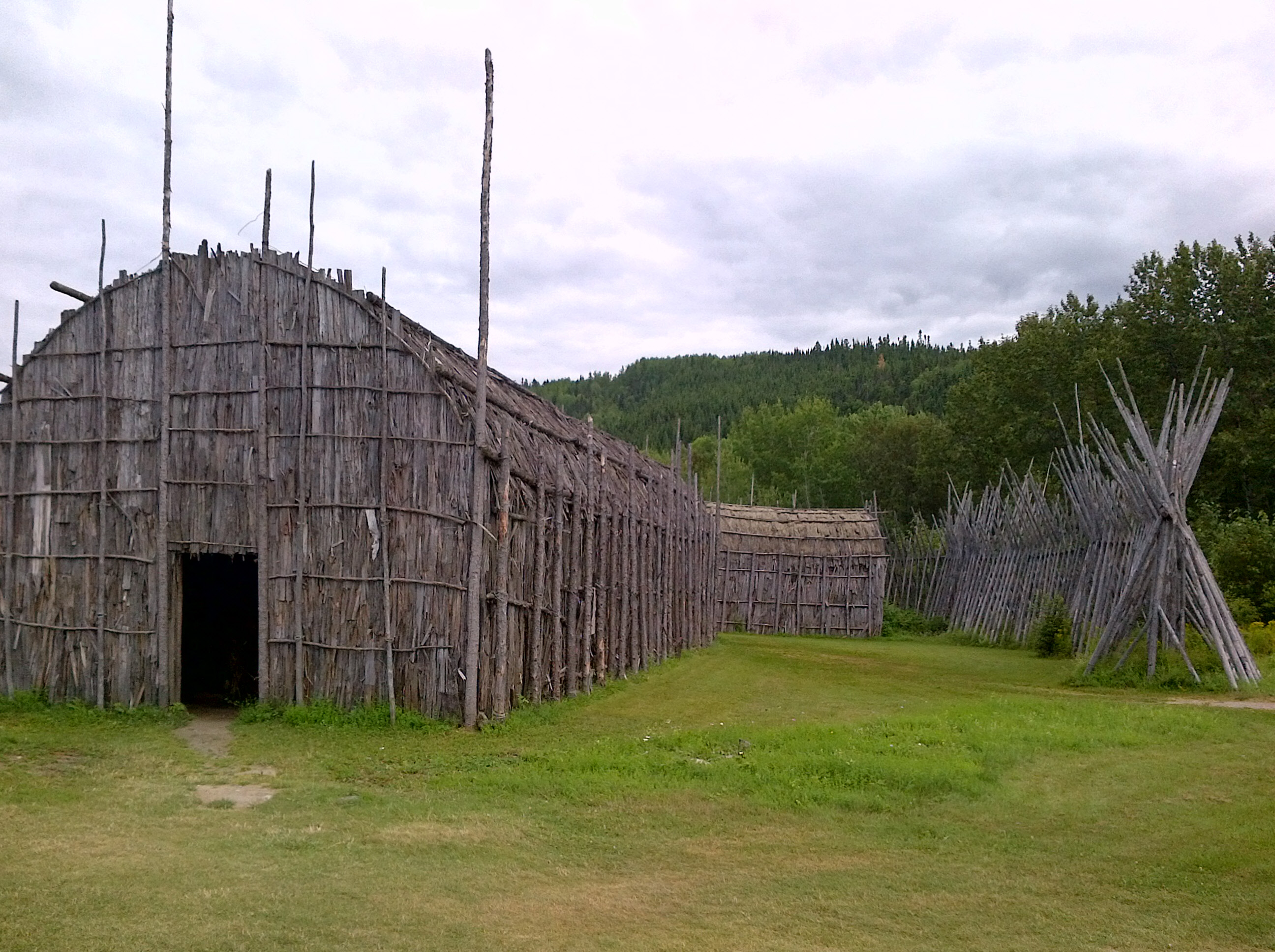
| "Reconstruction of a Huron longhouse for the film "Robe Noire," site of la Nouvelle-France, Saint-Félix-d'Otis, Québec, Canada [tr. Amanda Grace Shu]." By Pierre5018 (Own work) [CC BY-SA 4.0 (http://creativecommons.org/licenses/by-sa/4.0)], via Wikimedia Commons.
I know what you're thinking. What's a Christmas carol post doing on my blog in January? Do I not know that Christmas is over?
Well, to that I say, 1) Hey, it ain't over until Epiphany happens, and 2) I didn't have this translation ready at Christmas, because I didn't discover this song until after Christmas, and I can't stand to wait another year before sharing this with you all.
The Huron Carol is Canada's oldest Christmas carol, written by a Jesuit priest named Father John de Brébeuf, later canonized as one of the patron saints of Canada. (Yes, yes, here I must admit I'm American, not Canadian, but I'm a nerd, so of course I know who the patron saint of Canada is.) Father John lived among the Wendat/Huron people and wrote this carol in the Wendat language, making this one of the first texts written in Wendat. A popular English translation was created by Jesse Edgar Middleton in 1926, but his translation has been criticized for its confusion of different native cultures and Western use of broad generalizations about what they think "Native American" culture should be. Nevertheless, alternative translations are few and limited to a few verses as in the Heather Dale cover of the song in English, French, and Wendat.
I discovered this carol through Heather Dale's song and went digging for a direct translation from Wyandot to English, the only one of which I found at Diversity Tree. Andrea Shallay, author of the Diversity Tree article, writes: "I was moved by the intimate and respectful tone of the original lyrics. Instead of using made-up native images to fit a nativity story, it is a theological discussion tapping into images and values shared by both Christian and traditional Huron beliefs. Cultural references are not thrown around lightly, nor is the meaning of the images compromised for either party. It is not a tool for conversion because the lyrics require the Huron people to share what was important to them just as Father de Brébeuf could share what was important to him. I find the traditional lyrics of the Huron Carol to be a carol of respect and cultural exchange, attempting to translate meaning across cultural boundaries."
With this as my mission statement and both the direct English translation and the French translation as my guides, I set out to write a rhyming, metrically-fitting English translation of the Huron Carol. Note: I do not speak Wendat at all and am not a member of the First Nations. If my translation is inaccurate, disrespectful, or is surpassed by a translation written by a member of the Huron tribe, please defer to those from whose culture this song comes. If you are a member of the Huron tribe or speak the Wendat language, do not hesitate to contact me with notes on this translation. I am always eager to learn more.
The Huron Carol |
Showing posts with label indigenous peoples. Show all posts
Showing posts with label indigenous peoples. Show all posts
Sunday, January 3, 2016
Translation: The Huron Carol


Subscribe to:
Posts (Atom)