 |
Image description: a silhouette of a raven in flight, magically vanishing into smoke, with a background of swirling nebulae and stars. Photo edit by Amanda Grace Shu. |
Showing posts with label religion. Show all posts
Showing posts with label religion. Show all posts
Wednesday, May 23, 2018
Kevarya: An Introduction to Magic

Saturday, November 26, 2016
Prophecy

Foreground digital painting of character i-Aten Elena drawn © Amanda Grace Shu 2016. Background image source credit to Frank Vincentz via Wikimedia Commons.
It's
time to introduce you to a new character in the Kevarya
Universe, one completely unrelated to the Royal Family with
which A
Winter's Ball was
so concerned. Their name is i-Aten Elena, or just Elena, and they
provide the first hint of magic at
play.
Now
a note about Elena. Elena is what's known as genderfluid,
a term which may trip up some people. Genderfluidity, according
to Genderfluid
Support, can be defined as "the
feeling of fluidity within your gender identity; feeling a different
gender as time passes or as situations change; not restricted to any
number of genders." Elena uses singular they pronouns (they/them/theirs). Is this grammatically correct? Yes, of course it is. The singular "they" was even named the American Dialect Society's Word of the Year in 2015. Pronouns have changed from plural to singular before, and since language itself is constantly changing, the idea of what is grammatically correct is rather, shall we say... fluid. Like gender. Or, for example, the nature of Time Itself.
Speaking of which...
Prophecy
Saturday, April 23, 2016
Curst Be He
 |
| On the left, John Donne, 17th-century poet and priest, painted by an unknown artist circa 1595. On the right, William Shakespeare,17th-century poet, playwright, and wearer of a stylish earring, attributed to John Taylor circa 1610. |
"Why don't you ask him yourself?" said one necromancer, Miss Siona Donne. She promptly proceeded to throw open a curtain, revealing not only the zombie of her ancestor John Donne, but a Zombie William Shakespeare as well. (Zombies, in this universe, are well-possessed of their minds and do not require a diet of brains, barring the results of any fits of nostalgia they may have for Tudor-era chicken-brain blancmange.)
This brought many, many questions to my mind. Is this the reason Shakespeare's skull is missing from Holy Trinity Church? Didn't Shakespeare put a curse on his grave, and if so, what would it do to our gutsy necromancer? What's the relationship between Zombie Shakespeare and Zombie Donne? And why would someone want to raise Shakespeare from the dead in the first place?
Of course, the only acceptable answer comes in the form of a short story.
Good
frend for Iesvs sake forebeare,
To digg the dvst encloased heare.
Bleste be the man that spares thes stones,
And cvrst be he that moves my bones.
To digg the dvst encloased heare.
Bleste be the man that spares thes stones,
And cvrst be he that moves my bones.
—epitaph
of William Shakespeare, inscribed on his grave at Holy Trinity Church
Sunday, January 3, 2016
Translation: The Huron Carol
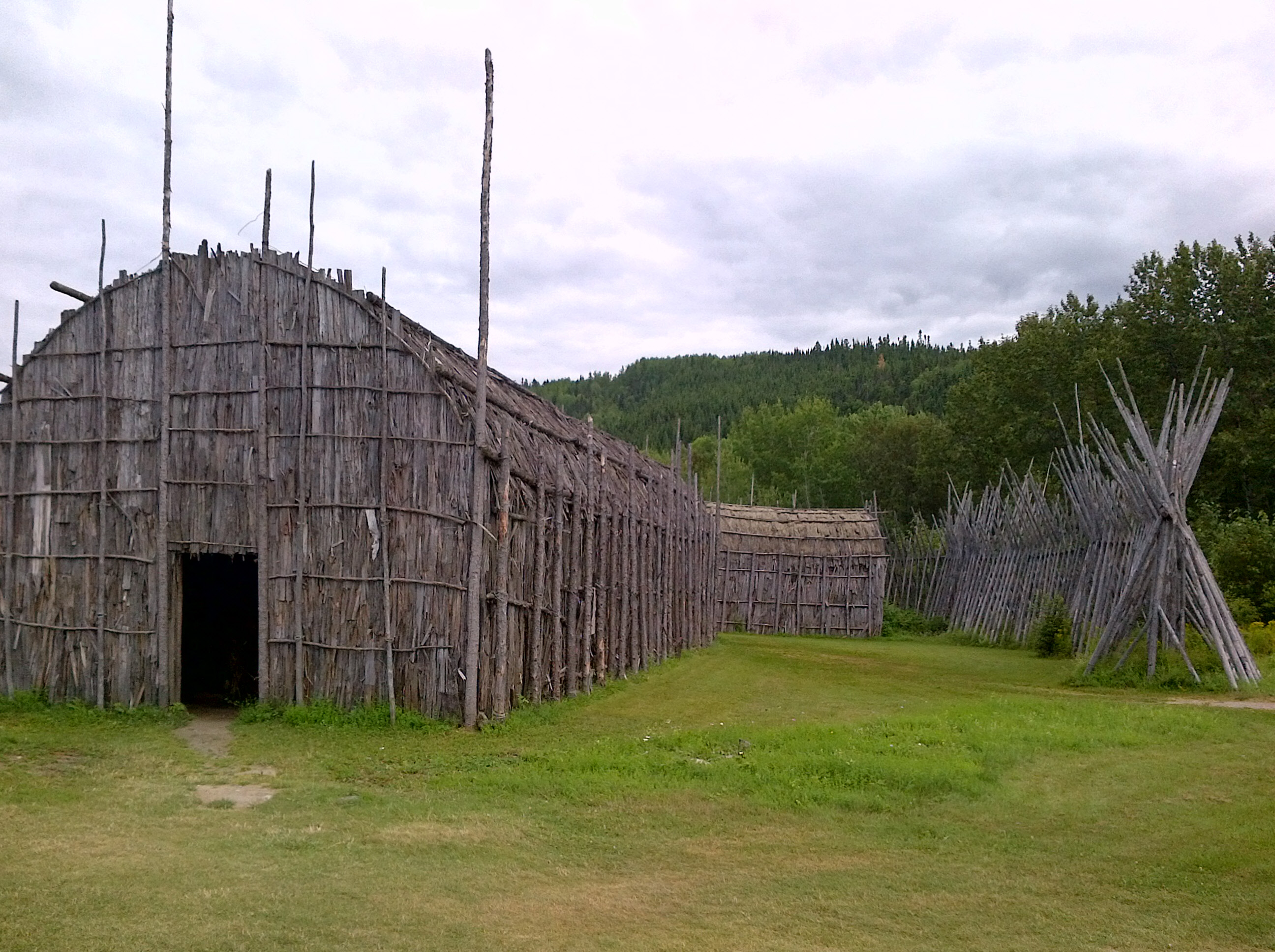 |
| "Reconstruction of a Huron longhouse for the film "Robe Noire," site of la Nouvelle-France, Saint-Félix-d'Otis, Québec, Canada [tr. Amanda Grace Shu]." By Pierre5018 (Own work) [CC BY-SA 4.0 (http://creativecommons.org/licenses/by-sa/4.0)], via Wikimedia Commons.
I know what you're thinking. What's a Christmas carol post doing on my blog in January? Do I not know that Christmas is over?
Well, to that I say, 1) Hey, it ain't over until Epiphany happens, and 2) I didn't have this translation ready at Christmas, because I didn't discover this song until after Christmas, and I can't stand to wait another year before sharing this with you all.
The Huron Carol is Canada's oldest Christmas carol, written by a Jesuit priest named Father John de Brébeuf, later canonized as one of the patron saints of Canada. (Yes, yes, here I must admit I'm American, not Canadian, but I'm a nerd, so of course I know who the patron saint of Canada is.) Father John lived among the Wendat/Huron people and wrote this carol in the Wendat language, making this one of the first texts written in Wendat. A popular English translation was created by Jesse Edgar Middleton in 1926, but his translation has been criticized for its confusion of different native cultures and Western use of broad generalizations about what they think "Native American" culture should be. Nevertheless, alternative translations are few and limited to a few verses as in the Heather Dale cover of the song in English, French, and Wendat.
I discovered this carol through Heather Dale's song and went digging for a direct translation from Wyandot to English, the only one of which I found at Diversity Tree. Andrea Shallay, author of the Diversity Tree article, writes: "I was moved by the intimate and respectful tone of the original lyrics. Instead of using made-up native images to fit a nativity story, it is a theological discussion tapping into images and values shared by both Christian and traditional Huron beliefs. Cultural references are not thrown around lightly, nor is the meaning of the images compromised for either party. It is not a tool for conversion because the lyrics require the Huron people to share what was important to them just as Father de Brébeuf could share what was important to him. I find the traditional lyrics of the Huron Carol to be a carol of respect and cultural exchange, attempting to translate meaning across cultural boundaries."
With this as my mission statement and both the direct English translation and the French translation as my guides, I set out to write a rhyming, metrically-fitting English translation of the Huron Carol. Note: I do not speak Wendat at all and am not a member of the First Nations. If my translation is inaccurate, disrespectful, or is surpassed by a translation written by a member of the Huron tribe, please defer to those from whose culture this song comes. If you are a member of the Huron tribe or speak the Wendat language, do not hesitate to contact me with notes on this translation. I am always eager to learn more.
The Huron Carol |
Saturday, October 31, 2015
Black Sand

An animated GIF banner made by me, with the help of Adobe Photoshop, for the Danse Macabre universe.Happy Halloween, All Saint's Eve, Samhain, and all the other holidays and celebrations going on this October 31! I bring you a spooky story from an ongoing project called Danse Macabre, a roleplay universe written in collaboration with the fantastic Jay B. I'm not entirely sure how well the story stands on its own, as it was written as a prequel to the main roleplay, but we'll see how it goes.
Black
Sand
Tuesday, December 24, 2013
The Holly and The Ivy
Christmastime is here... unless you don't celebrate Christmas. But for those who do...
Reflecting on the Lessons and Carols service I heard in church last Sunday, I rewrote the lyrics to the classic Christmas song "The Holly and The Ivy" to bring the Ivy into prominence alongside the Holly--Jesus' life alongside Jesus' death. The lyrics appear under the cut.
Happy Holidays to all, and to all a good night!
The Holly and The Ivy
Sunday, April 21, 2013
Hope for the Flowers


From http://wallpaperstock.net/butterfly-light_wallpapers_5363_1280x1024_1.html, courtesy of The Internet.Because our city, our nation, and all our souls could certainly do with some hope.
Here is a video of me reading my poem "To Sing to a Butterfly" alongside composer Erik Gustafson's prelude of the same name (directly inspired by the poem) as part of a piano rededication service at Old South Church in Boston, my home church and the proudly-proclaimed Church of the Finish Line, just down the street from the site of Monday's explosions. The church is now closed off as part of the crime scene; we are denied access to the beautiful pianos and stained-glass windows lying just beyond the barricade. Every one of us is—just as everyone in and outside of the city is—shaken. Sometimes, it feels as if the world is coming to an end.
But there is a quote, a beautiful quote from an anonymous sage who knows that just when the caterpillar thought the world was over, she became a butterfly. "Shaken but not forsaken," Old South continues to worship as a community, graciously hosted by the Church of the Covenant a few blocks away. Today we walked together to the boundaries of the crime scene to reclaim our finish line by singing hymns. My life flows on in endless song, above Earth's lamentation. Let there be peace on earth, and let it begin with me. Guide my feet, hold my hand, wheel with me while I run this race. This little light of mine, I'm gonna let it shine, let it shine, let it shine, let it shine...
Just when we think the world is over, defeated by grief and hate and violence, we can be transformed—not returned to the way things were before, but transformed, like butterflies, into something beautiful and profound, something that brings hope to the flowers.
"For this is the truth all nature-singers know:
When you sing to a butterfly,
you sing to yourself as well,
and you know that all things are possible."
http://www.youtube.com/watch?v=VC_5S-8s_mc
*listen to more of Erik's gorgeous music at http://erikmusik.net/
Friday, October 26, 2012
Angels

The Presentation in the Temple by Jean-Baptiste Jouvenet, the painting in the Smith College Museum of Art that hath inspired this poem. It depicts the Biblical story of presentation of Jesus in the temple, with a mournful-looking woman in the lower left-hand corner.Another one from my summer at Smith, but a poem this time!
This is one of my favorites from the poetry I wrote at the Smith workshop. We took a field trip to the Smith College Museum of Art and came up with poem ideas based the paintings we saw, then went back to the classroom and wrote them. There are probably twenty other ideas that I wrote down, but this is the only one that has actually been written (so far).
For some reason, it was ridiculously hard to find an image file on the internet of this painting. 1) Jouvenet painted two "Presentation in the Temple"s, the other of which is more well-known; 2) I had been spelling his name wrong for half of my search; and 3) those that I did find had watermarks on them. But I did find it eventually, so here it is in all its glory.
Enough of my rambling, which is probably longer than the poem itself. Enjoy!
Angels
(after
The Presentation in the Temple by Jean-Baptiste Jouvenet)
Subscribe to:
Posts (Atom)